January 27, 2026
January 27, 2026
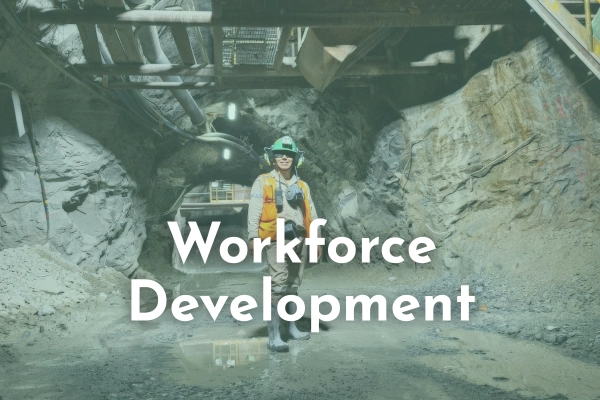
The minerals industry underpins nearly every aspect of modern life, supplying the raw materials that support infrastructure, manufacturing, food production, health care, technology, and national defense. Yet even as demand for these materials continues to grow, the minerals industry faces significant workforce development challenges that threaten its ability to operate efficiently and safely. These challenges are not driven by geology or resource availability, but by human capital constraints that affect recruitment, training, and long-term workforce sustainability.
Across the United States, employers in the minerals industry face persistent difficulty attracting, training, and retaining skilled workers. The challenge is not simply a short-term hiring cycle. It is a structural workforce development problem shaped by demographics, education pipelines, geography, regulatory requirements, technology change, and public perception. If not addressed at scale, workforce shortages can slow project timelines, increase safety risks, raise costs, and weaken domestic supply resilience.
A central issue is the industry’s age profile. Many experienced workers are approaching retirement, and their departure creates more than a headcount gap. It creates a “knowledge cliff” where site-specific expertise, equipment intuition, and hard-earned safety judgment leave with them.
Several analyses estimate that retirements will be substantial in the coming years. The Society for Mining, Metallurgy & Exploration (SME) has projected that by 2029 more than half of the current workforce will have retired and need to be replaced, a figure often summarized as roughly 221,000 workers. This is not a challenge that can be solved by a single recruiting push. It requires multi-year pipeline development that starts well before job offers are made.
Retirement risk also compounds a second issue: the long ramp-up time for proficiency in many roles. Even when new hires are available, developing competence in operations, maintenance, safety compliance, and supervisory decision-making takes time and structured mentorship. If retirements outpace onboarding and training, operations can become increasingly dependent on a thinner layer of experienced personnel.
Workforce development begins upstream, but the minerals industry is often underrepresented in mainstream career pathways. Many K–12 programs, community colleges, and universities provide limited exposure to minerals-related careers compared to more visible sectors. In practice, that means the industry is frequently absent from student assumptions about what “good jobs” look like and where innovation is happening.
The pipeline challenge is particularly acute for specialized technical fields. SME and other observers have highlighted a mismatch between replacement needs and the number of relevant degrees awarded in the United States, especially in mineral engineering disciplines. While not every critical role requires a four-year degree, shortages in engineering, geology, metallurgy, and certain safety functions are difficult to offset quickly through lateral hiring.
A related problem is that many training programs are fragmented. In some regions, strong programs exist, but they are not consistently scaled, aligned with employer needs, or supported with work-based learning that helps students translate credentials into job readiness.
The minerals industry often operates in rural or remote locations, while many workforce growth trends are concentrated in metro areas. This geographic mismatch makes recruiting more complex and raises the stakes for local pipeline development.
In remote communities, the available labor pool may be smaller, and the same workers are often competed for by multiple industrial employers (construction, energy, transportation, utilities). Housing availability, commute distances, and limited access to childcare and healthcare can further reduce mobility and retention, particularly for early-career workers and dual-career households.
The result is that employers may need to “build” talent locally, which takes time, consistent partnerships, and predictable demand signals that justify program capacity.
Safety is non-negotiable in the minerals industry, and robust training regimes are a core part of preventing serious incidents. At the same time, required training and retraining can add onboarding friction and cost, particularly when training capacity is limited.
Federal rules distinguish between training requirements under different regulatory parts, and they establish minimum refresher obligations. For example, federal regulations require no at least eight hours of annual refresher training for covered workers. (eCFR) The Mine Safety and Health Administration (MSHA) also maintains guidance and training resources that outline how operations can meet these obligations, including the differentiation between training frameworks.
These requirements are appropriate and necessary, but they shape the workforce challenge in practical ways. New entrants often need structured time before they can contribute fully, and smaller operations can struggle to deliver compliant training at scale without dedicated resources.
Many high-demand roles in the minerals industry overlap with broader skilled-trades shortages across the U.S. economy. Equipment mechanics, industrial electricians, welders, heavy equipment operators, instrumentation technicians, and safety professionals are also sought by construction, manufacturing, and energy employers. When those sectors offer perceived lifestyle advantages, more predictable schedules, or urban locations, the minerals industry must work harder to compete.
Compensation is often strong, but compensation alone rarely solves a pipeline problem. A Senate Health, Education, Labor and Pensions (HELP) Committee testimony on building the critical minerals workforce noted that average wages in this sector are above the national average, yet shortages persist. This underscores a core point: the constraint is not simply pay. It is the availability of qualified candidates, the speed of training, and the ability to retain people once trained.
Automation, remote operations, condition-based maintenance, data analytics, and digital safety systems are changing the work. That is good for productivity and safety, but it also changes the skill profile employers need.
The industry increasingly requires hybrid talent: workers who can operate and maintain sophisticated equipment, interpret digital diagnostics, follow cybersecurity hygiene, and participate in continuous improvement cultures. This shift puts pressure on training programs to modernize curricula, and it can disadvantage operations that lack the internal capacity to upskill incumbent workers.
It also creates a messaging opportunity. The minerals industry is more technologically advanced than many job seekers assume, but that reality often does not reach the audiences that matter most.
Public perception affects recruitment. Young workers and career changers increasingly evaluate employers based on culture, safety, purpose, community impact, and advancement pathways. If the minerals industry is associated with outdated stereotypes, it will lose candidates before they ever engage with job postings.
Recent commentary by the Forbes Business Council has emphasized that perception, awareness, and education are central levers for addressing workforce shortages. While the underlying drivers vary by region and commodity, the recruitment narrative is consistently a factor: people need to understand what the work is, what the career trajectory looks like, and why it matters.
Solving workforce development in the minerals industry requires coordinated action rather than isolated initiatives. The most effective strategies tend to share several characteristics:
Workforce development challenges in the minerals industry are real, measurable, and solvable, but only with sustained investment and coordination. Demographic pressures, constrained education pathways, geographic realities, compliance requirements, and rapidly evolving skill needs all interact to create today’s labor shortage.
The good news is that the same factors creating pressure also create opportunity. With clear career pathways, modern training partnerships, and a stronger narrative about the industry’s role in everyday life and national resilience, the minerals industry can build the workforce it needs for the next decade.
August 12, 2026
July 30, 2026

July 29, 2026