July 29, 2026
July 29, 2026
Birthstones have long been tied to the months of the year, valued for their color, rarity, and symbolic meaning. They show up in jewelry, anniversary traditions, and gift-giving customs around the world. But their significance runs deeper than ornamentation. The minerals behind birthstones are shaped by the same geological forces that supply essential materials to modern industry. Long before they are cut and polished, these minerals are prized for properties like hardness, thermal stability, and chemical resistance. Today, birthstone minerals and their chemical cousins support manufacturing, defense systems, medical technology, and space exploration.
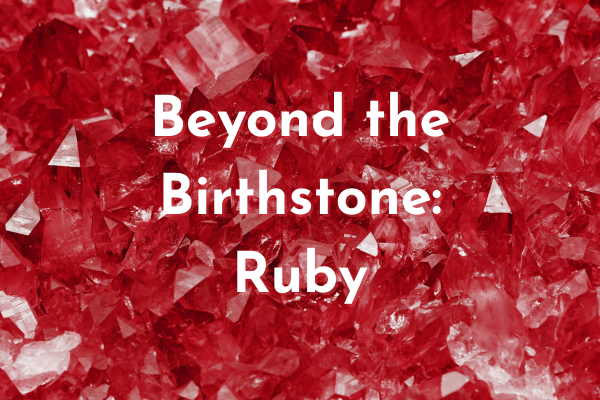
July's birthstone is the ruby — the red variety of corundum, an aluminum oxide mineral (Al₂O₃) that rates 9 on the Mohs hardness scale, second only to diamond. What makes corundum red is the same mechanism that made it scientifically important: trace amounts of chromium replace aluminum ions within the crystal structure, producing the deep red color that defines a fine ruby. Shift the chemistry — add iron and titanium instead of chromium — and corundum becomes blue sapphire. The mineral is the same; the trace elements tell the difference. Corundum's hardness, combined with its exceptional thermal stability and chemical inertness, drives a range of industrial applications that have little to do with gemstones and everything to do with performance under extreme conditions.
Fine rubies are among the rarest gemstones in the world, and their geology explains why. Corundum requires aluminum-rich rocks conspicuously low in silica — because silicon and aluminum compete for the same structural sites, and silica wins, preventing corundum from forming. That rules out most of the Earth's crust.
The world's most prized rubies form in marble-hosted metamorphic deposits, where ancient limestone has been transformed by the heat and pressure of tectonic collision. The Mogok Stone Tract in Myanmar — long considered the benchmark for ruby quality — formed during the collision of the Indian and Eurasian plates, which metamorphosed carbonate rocks into the marble where chromium-bearing corundum could crystallize. According to research published in Minerals, this ruby mineralization occurred roughly 25 million years ago during high-temperature metamorphic events associated with that collision. The resulting stones are iron-poor, which gives Mogok's finest rubies their intense fluorescence and the saturated red sometimes described as "pigeon's blood." Other important sources include Mozambique, Madagascar, Thailand, Sri Lanka, and Vietnam, each with distinct geological settings and characteristic trace element profiles. Rubies also occur in alluvial deposits, where weathering and erosion have freed crystals from their host rock and concentrated them in riverbeds and sediments.
Most corundum used in industry today is not mined as a gemstone. It is manufactured. Fused aluminum oxide — produced by smelting bauxite or alumina at high temperatures — is the industrial workhorse of the corundum family, and it is used at a scale that makes gem-quality ruby production look negligible by comparison.
The dominant application is abrasives. Bonded and coated abrasive products account for most industrial uses of fused aluminum oxide, according to the USGS Mineral Commodity Summaries. In 2024, U.S. apparent consumption of fused aluminum oxide was approximately 110,000 metric tons, with additional significant volumes of silicon carbide and metallic abrasives. Grinding wheels, sandpaper, polishing compounds, cutting discs, and blasting media made from aluminum oxide are essential across metal fabrication, aerospace component production, automotive manufacturing, and toolmaking — wherever manufacturers need to hold tight tolerances and consistent surface finishes at production volume.
The connection between ruby and lasers is more than metaphorical. On May 16, 1960, physicist Theodore Maiman at Hughes Research Laboratories demonstrated the world's first working laser using a synthetic ruby crystal — a fingertip-sized rod of aluminum oxide doped with chromium, the same chemistry that makes a ruby red. That original crystal, now held at the Smithsonian's National Museum of American History, produced pulses of coherent red light at 694.3 nanometers. The ruby laser opened an era that now reaches into surgery, manufacturing, communications, and defense. Ruby lasers themselves continue in niche applications in laser technology including holography and non-destructive testing, where their specific wavelength and high peak power remain useful. In medicine, ruby lasers were early tools in dermatology; the broader field of laser medicine they helped establish now encompasses eye surgery, cancer treatment, and precision procedures across nearly every surgical specialty.
Beyond abrasives and lasers, synthetic corundum — particularly in the form of synthetic sapphire (pure, single-crystal Al₂O₃) — has become a critical material in electronics and optics. Sapphire wafers serve as substrates for gallium nitride-based LEDs, a foundational component of modern lighting and display technology. Millions of sapphire wafers are processed annually for LED applications worldwide. Sapphire is also used in silicon-on-sapphire semiconductor circuits for high-power radio frequency applications found in cellular phones, satellite communications, and public-safety radio systems. Its hardness and chemical resistance make it the material of choice for watch crystals, smartphone camera lenses, fingerprint sensor covers, and optical windows in military and aerospace systems.
In wear-resistant components, synthetic ruby and sapphire appear in precision bearings, nozzles, thread guides, and instrument components where abrasion resistance and dimensional stability are non-negotiable over long service lives. These are applications where the difference between a component that lasts and one that fails early is measured in material hardness — and at Mohs 9, corundum offers a clear advantage over nearly everything except diamond.
Ruby is July's birthstone because of its color: that chromium-driven red has captivated people for millennia. But chromium is also what made a synthetic ruby crystal the right medium for the world's first laser. And the aluminum oxide at the core of both is what makes corundum indispensable in abrasive tools, semiconductor substrates, optical systems, and precision components across the modern economy. Minerals make it happen.
September 30, 2026

September 25, 2026
August 27, 2026