
September 30, 2026
September 30, 2026
Birthstones have long been tied to the months of the year, valued for their color, rarity, and symbolic meaning. They show up in jewelry, anniversary traditions, and gift-giving customs around the world. But their significance runs deeper than ornamentation. The minerals behind birthstones are shaped by the same geological forces that supply essential materials to modern industry. Long before they are cut and polished, these minerals are prized for properties like hardness, thermal stability, and chemical resistance. Today, birthstone minerals and their chemical cousins support manufacturing, defense systems, medical technology, and space exploration.
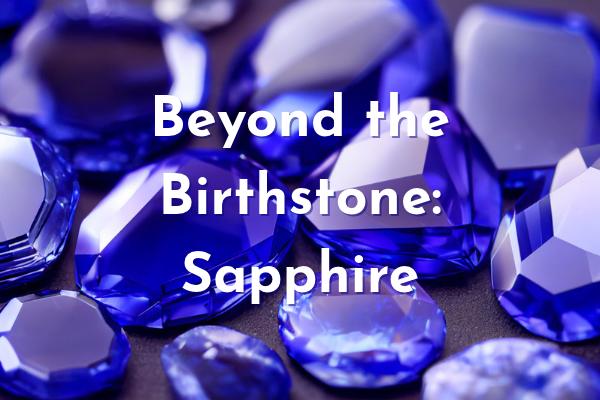
September's birthstone is the sapphire. Like July's ruby, sapphire is a variety of corundum — aluminum oxide (Al₂O₃) — rating 9 on the Mohs hardness scale. What separates sapphire from ruby is trace element chemistry: while chromium gives ruby its red, iron and titanium give sapphire its blue. Change the trace elements further and corundum becomes yellow, pink, green, or orange — every variety except red is called sapphire. The finest blue sapphires have historically come from Kashmir, Myanmar, and Sri Lanka, where metamorphic and alluvial geology produces exceptional color and clarity. Today Madagascar is the world's largest sapphire producer. Within the United States, Montana's Yogo Gulch is the primary source, known for a distinctive cornflower blue and natural clarity that requires no heat treatment — unusual in the sapphire trade.
Sapphire forms in two primary geological settings. The first is metamorphic: aluminum-rich rocks poor in silica are subjected to intense heat and pressure — in the case of Kashmir, during the Himalayan uplift that began roughly 50 million years ago when the Indian subcontinent collided with Asia. Those geological forces metamorphosed rocks into the corundum-bearing formations that produced what many consider the finest sapphires ever found. Kashmir's deposit was commercially mined for only about 50 years, from the 1880s through the 1930s, and true Kashmir sapphires are now essentially finite.
The second setting is igneous: many of the world's commercially important sapphires — in Australia, Madagascar, Montana, and Thailand — form in or near alkaline basaltic rocks, where partial melting of the mantle produces magmas that carry or create corundum crystals as they cool. Iron and titanium in these environments give basalt-associated sapphires their characteristically deep, saturated blue. Most commercial deposits are alluvial — corundum's hardness (Mohs 9) and high density allow it to survive erosion and concentrate in riverbeds and sediments, where it has been mined for more than 2,000 years in Sri Lanka alone.
The sapphire that drives modern industry is not mined from these deposits. It is grown. Synthetic sapphire — pure, single-crystal aluminum oxide produced in laboratory furnaces — replicates the hardness, thermal stability, optical transparency, and chemical inertness of the natural gem at industrial scale and consistency. The global sapphire substrate market was valued at approximately $1.43 billion in 2026 and is projected to reach $3.26 billion by 2035, driven primarily by electronics and defense applications.
The dominant application is LED lighting. Sapphire wafers serve as the substrate on which gallium nitride (GaN) layers are grown to produce light-emitting diodes. The combination works because sapphire's crystal structure is compatible with GaN epitaxial growth and its transparency allows light to pass through cleanly. LED lighting accounts for over 40 percent of total sapphire substrate demand, and the market for GaN-on-sapphire LED wafers alone was valued at $4.25 billion in 2025, with projections toward $8.96 billion by 2035, according to Spherical Insights. The U.S. Department of Energy has supported development of patterned sapphire substrates — wafers with micro- or nanoscale surface patterns that reduce crystal defects and improve light extraction — as part of national energy efficiency goals.
In semiconductor and radio frequency (RF) electronics, synthetic sapphire wafers serve as insulating substrates for silicon-on-sapphire (SOS) circuits used in high-power radio frequency applications — the kind found in 5G base stations, satellite communications, and public-safety radio systems. GaN devices built on sapphire substrates operate at voltages exceeding 650 volts while delivering higher efficiency than conventional silicon, according to semiconductor industry analysis. Global deployment of 5G networks has resulted in millions of RF amplifier units using GaN technology on sapphire platforms.
In defense and aerospace, sapphire's combination of optical transparency, extreme hardness, and resistance to heat and chemical attack makes it one of a small group of materials suitable for transparent armor applications. Single-crystal sapphire is among the primary materials under evaluation for ballistic-resistant transparent armor in armored vehicles and aircraft, alongside aluminum oxynitride (ALON) and spinel. Sapphire optical windows are used in surveillance systems, missile dome covers, and space exploration equipment where clarity must be maintained across UV, visible, and infrared wavelengths under harsh conditions. Its scratch resistance — at Mohs 9, it yields only to diamond — makes it the material of choice for watch crystals, smartphone camera lenses, and fingerprint sensor covers in commercial applications as well.
In precision and wear-resistant components, synthetic ruby and sapphire components appear in bearings, nozzles, thread guides, and analytical instrument parts where abrasion resistance and dimensional stability over long service lives are non-negotiable. These are low-profile applications, but they are found across medical devices, industrial machinery, and laboratory instruments.
The September birthstone is the same aluminum oxide that lines the precision instruments in a laboratory, the camera lens on a modern smartphone, and the transparent armor panel on a military vehicle. Its color comes from trace amounts of iron and titanium. Its industrial value comes from everything else — hardness, transparency, chemical inertness, and thermal stability that no common material matches. Minerals make it happen.
September 30, 2026

September 25, 2026
August 27, 2026