April 14, 2026
April 14, 2026
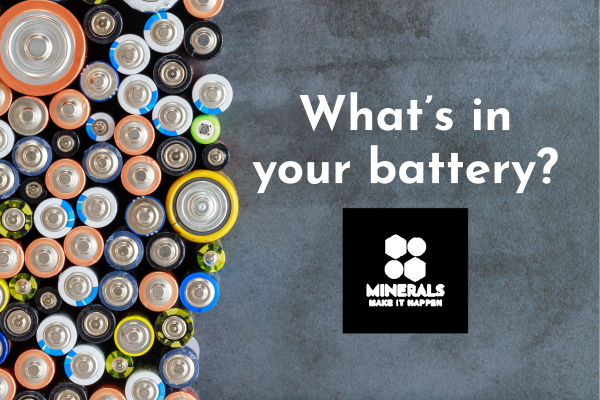
Every battery that powers modern life — from your car to the electric grid — starts with minerals that come from the earth. A new EMA technical paper breaks down exactly which ones, and why they matter.
We don't often think about what's inside a battery. We think about range anxiety, charging times, and whether our phone will make it to the end of the day. But underneath all of that is a minerals story that runs from salt flats in South America to processing facilities in China to the vehicles and devices in our daily lives.
The Essential Minerals Association has published a new technical paper surveying the major rechargeable battery chemistries in commercial use today and the critical minerals that make each one possible. Here are the highlights.
The oldest rechargeable battery in widespread use — the lead-acid battery under the hood of most conventional vehicles — runs on lead and sulfuric acid. It's heavy and not particularly energy-dense, but it's inexpensive, reliable, and one of the most successfully recycled products ever made, with lead recovery rates exceeding 95 percent.
Nickel-based batteries, which powered the first generation of hybrid vehicles and countless consumer devices, rely on nickel and rare earth elements like lanthanum and cerium. The Toyota Prius ran on nickel-metal hydride batteries for years before lithium-ion took over.
And then there's lithium-ion, the dominant technology today, and itself a family of related chemistries rather than a single formula. A typical electric vehicle battery contains roughly 20 pounds of lithium, 80 pounds of nickel, 55 pounds of manganese, 29 pounds of cobalt, and 146 pounds of graphite. Each mineral plays a specific role: lithium carries the charge, nickel drives energy density, cobalt and manganese stabilize the cathode, and graphite forms the anode.
One of the most significant developments in the battery world over the past five years is the rapid rise of lithium iron phosphate, or LFP, batteries. LFP chemistries swap out nickel and cobalt — two expensive and geopolitically sensitive minerals — for iron and phosphate. The result is a battery that costs roughly 30 percent less than conventional lithium-ion, lasts significantly longer, and is far less prone to overheating.
LFP now supplies nearly half the global electric vehicle market, up from less than 10 percent in 2020. That shift has moved phosphate and battery-grade iron to the center of supply chain conversations that were previously dominated by cobalt and nickel.
Meanwhile, sodium-ion batteries are advancing as a promising option for grid-scale storage. Sodium is one of the most abundant elements on earth, globally distributed, and dramatically cheaper than lithium. The tradeoff is lower energy density — but for stationary storage applications where weight isn't the primary concern, that tradeoff looks increasingly acceptable.
The demand trajectory for battery minerals is steep. According to the International Energy Agency, demand for lithium could grow more than 40 times by 2040. Graphite, cobalt, and nickel demand could grow 20 to 25 times over the same period.
That kind of growth puts enormous pressure on supply chains that are, in many cases, highly concentrated. A single country accounts for more than 70 percent of global cobalt supply and a similar share of natural graphite. China controls most of the global processing capacity for most key battery minerals.
Domestic minerals production is a central part of the solution. The United States has meaningful reserves of several battery minerals, and the existing industrial base — including soda ash production in Wyoming, which is directly relevant to lithium-ion battery supply chains — provides a foundation for building more resilient, more domestically anchored battery supply chains.
The full EMA technical paper covers each battery chemistry in depth, along with a detailed review of mineral-specific supply chain risks and the role of domestic minerals production in addressing them.

September 30, 2026

September 25, 2026
August 27, 2026