Home // Blog // Safety Starts at the Top: A Leader's Guide to Mobile Equipment Incident Prevention

May 6, 2026

Safety Starts at the Top: A Leader's Guide to Mobile Equipment Incident Prevention

Follow Us!

Written by Ryan Langton, director of environmental, health, safety, and sustainability at Huber Engineered Materials

In today’s minerals industry, organizational leaders play a pivotal role in shaping how mobile equipment is leveraged to drive productivity across their worksites. With demanding production goals, increasing competition, and advancing technology, the strategic decisions leaders make directly impact both operational performance and safety outcomes.

Powered haulage, which includes both surface mobile equipment and machinery used to transfer materials, continue to be the leading sources of fatal incidents. From 2020-2023, 31 percent (42) of all occupational fatalities in mining were attributed to machinery incidents, while 28 percent (38) were attributed to powered haulage incidents. The trend was maintained in 2024 and 2025 with these categories attributing to the largest number of fatal incidents.

MSHA data and investigations tell us that these incidents are preventable, and many of them are attributable to seemingly common-sense safety measures. MSHA’s 2021 recommendations on “Powered Haulage Equipment Safety” recommends the corrective measures of:

  • Providing task training to mobile equipment operators that includes blind spot awareness, and safe approach practices for pedestrians interacting with mobile equipment.
  • Reinforcing safe behaviors and effective communication, which includes making eye contact with operators when approaching mobile equipment.
  • Avoid parking light vehicles (pickup trucks, utility vehicles, etc.) near mobile equipment.
  • Implementing effective site traffic management plans that include speed limits, traffic patterns, and separating light vehicles from mobile equipment where possible. 
  • Using seat belts in equipment at all times.

While these recommendations and root causes are straightforward, the trends continue.  As a leader, here are some actions you can take in your organization to prevent mobile equipment incidents: 

  • Begin each conversation with safety. When conducting a site visit, focus on beginning each conversation with safety before discussing production. Ask operators, “What do you rely on to stay safe here?” and provide positive reinforcement for the safe behaviors you observe.
  • Use Leading Indicators. Assessing effectiveness of control measures through observation and data rather than the presence of incidents can indicate broader safety trends with mobile equipment operations. Near hit reports, telematics trends, pre-shift mobile equipment inspections and deficiency correction, can all be beneficial in understanding hazards before they become incidents.
  • Evaluate the effectiveness of controls. Human error is normal, and systems must be designed to prevent those mistakes from causing incidents. Even seasoned operators make mistakes, and systems should be designed to assume variability and human error. To understand obstacles to compliance, ask operators, “What makes doing this hard?” Understand what measures are in place to prevent accidents: collision avoidance systems, proximity detection features, backup alarms, and blind-spot cameras can all help alleviate risks from human error.
  • Train front-line leaders. Front-line leaders are expected to serve as champions of safety, leading by example and reinforcing safe behavior with their teams.

Ultimately, preventing safety incidents is not a matter of awareness alone but of leadership commitment. Safety culture is established by what leaders prioritize, model, and reinforce every day. When executives, managers, and supervisors consistently demonstrate that safety is non-negotiable, through their words, decisions, and actions, that expectation cascades throughout the organization. Investing in effective controls, empowering front-line leaders, and holding all levels of management accountable signals that production never comes at the expense of people. In the minerals industry, meaningful and lasting improvements in mobile equipment safety start at the top, and strong leadership is the most critical control of all.

Written by Ryan Langton, director of environmental, health, safety, and sustainability at Huber Engineered Materials, with more than 20 years of experience in the mining industry. Huber Engineered Materials, an EMA member company, is a global producer of specialty minerals, chemicals and biomaterials headquartered in Atlanta, GA

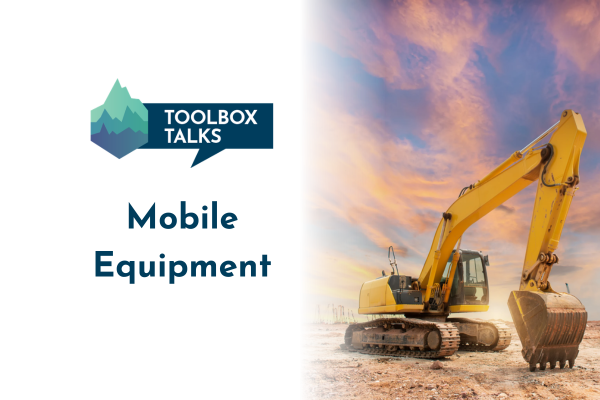
Learn more about mobile equipment safety in our toolbox talk.

Related Posts

Safety Starts at the Top: A Leader's Guide to Mobile Equipment Incident Prevention

Safety Starts at the Top: A Leader's Guide to Mobile Equipment Incident Prevention

May 6, 2026

Continue Reading
Beyond the Birthstone: Diamond (April) Industrial Precision Enabled by the World's Hardest Material

Beyond the Birthstone: Diamond (April) Industrial Precision Enabled by the World's Hardest Material

April 29, 2026

Continue Reading
Earth Day 2026: How Critical Minerals Make Renewable Energy Possible

Earth Day 2026: How Critical Minerals Make Renewable Energy Possible

April 21, 2026

Continue Reading