March 4, 2026
March 4, 2026
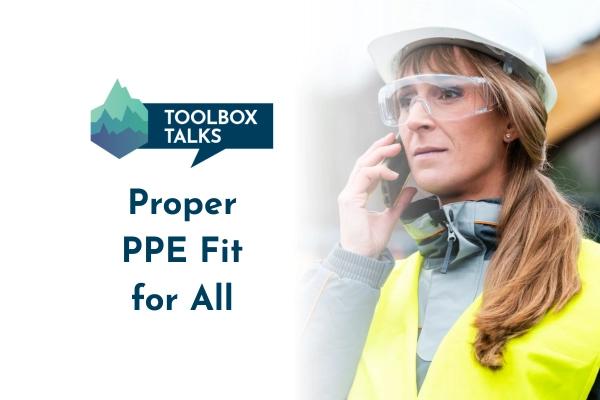
International Women’s Day is an opportunity to recognize the essential role women play across the minerals sector, and to confront the barriers that still inhibit safety, inclusion, and retention on mining worksites. One of the most persistent of these barriers is the lack of properly fitting personal protective equipment (PPE) for women.
Historically, PPE has been created around the dimensions of a “default worker,” typically male. For many women working in construction, manufacturing, energy, and mining, ill‑fitting gear remains an everyday reality. A large Canadian study conducted by the CSA Group found that half of nearly 3,000 women surveyed reported that their PPE does not fit properly, and 43 percent said it was uncomfortable to wear. Furthermore, 35 percent reported inadequate access to women‑specific PPE.
A related Workplace Safety & Prevention Services summary highlights that improper fit is linked to injuries, reduced mobility, and workplace incidents.
In mining, where workers navigate uneven ground, confined areas, heavy equipment, dust, vibration, and variable temperatures, these issues have amplified consequences.
Women today represent
These shifts are essential to addressing labor shortages across extraction, processing, and critical minerals supply chains. But growth in representation must be matched with growth in protection. When PPE doesn’t fit, workers often modify it using tape, rubber bands, or makeshift adjustments. These are actions that further compromise safety.
As the Essential Minerals Association continues advocating for safe, modern, and inclusive mining workplaces, our partnership with Red Wing reflects shared values around worker protection and dignity.
Red Wing brings a century-long legacy of designing purpose-built workwear. The company introduced its first women’s boot in 1926 and today uses female-specific engineering to build properly fitting footwear. Central to this approach is the use of a last, the three‑dimensional form (or mold) around which footwear is shaped. A last determines the boot’s internal structure, defining dimensions like heel width, arch height, toe room, and overall contour. Women’s lasts differ from men’s because women generally have narrower heels, different instep heights, and distinct forefoot proportions—features that can’t be achieved by simply scaling down a men’s boot.
Red Wing’s engineering teams also gather detailed measurement data through 3D foot‑scanning, allowing them to refine lasts, improve balance, reduce pressure points, and enhance long‑term comfort.
This partnership isn’t about promoting a specific product, it’s about accelerating industry understanding of what properly fitting PPE means, why it matters, and how it supports a safer, more inclusive mining workforce.
Beyond discomfort, poorly fitting PPE directly contributes to worker fatigue, a major risk factor in remote mining environments.
Here’s why:
Fatigue in mining is serious. When workers are physically worn down, reaction time decreases, decision-making declines, and the risk of incidents increases, especially around haul trucks, conveyors, crushers, and high‑energy equipment.
Better fit isn’t about comfort; it’s about keeping workers sharp, stable, and safe.
Fit affects more than safety outcomes, it affects worker dignity.
Proportional sizing and access to appropriately fitted gear protect workers’ privacy, hygiene, and personal comfort, particularly in environments where changing conditions, protective layering, and sanitation access vary widely.
For example:
These considerations may seem small in isolation, but collectively, they influence whether workers feel respected, included, and fully supported on site, all of which impact morale and retention.
Providing properly fitting PPE is not only the right thing to do, it’s the smart thing to do.
The CSA study found that Canadian regulations do not consistently require PPE to fit users properly, nor do they consistently reference up‑to‑date standards. While U.S. regulations (including OSHA standards) focus on hazard-appropriate PPE, the expectation that PPE “must fit properly” is increasingly recognized in inspections, risk assessments, and safety audits.
Proactively supplying well‑fitted PPE reduces:
Employers sometimes express concern about carrying gender‑inclusive inventory. But the long-term economics tell a different story:
Stocking a more inclusive range is not a cost center — it’s a risk‑reduction and value‑creation strategy.
This International Women’s Day, the Essential Minerals Association reaffirms its dedication to a mining industry where every worker is protected, respected, and equipped for success. Our collaboration with Red Wing underscores the power of partnership in advancing PPE innovation, raising awareness, and ensuring access to gear designed for everyone, not just the traditional “default.”
Because when PPE truly fits the worker wearing it, the entire mining sector becomes stronger, safer, and more resilient.
September 30, 2026
September 25, 2026
August 27, 2026