March 10, 2026
March 10, 2026
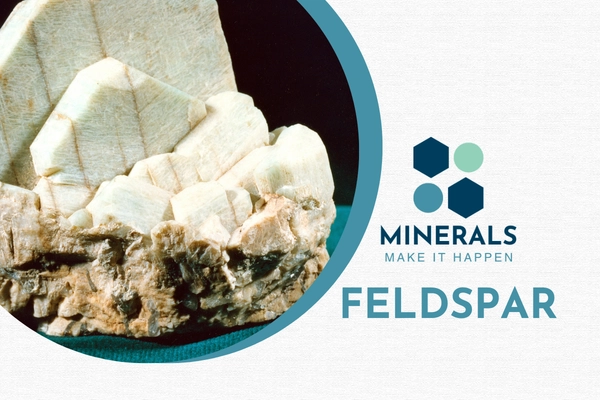
Feldspar isn't a single mineral — it's a family of closely related minerals that, taken together, make up more than half of Earth's crust. According to Encyclopaedia Britannica, feldspars are aluminosilicate minerals containing varying amounts of calcium, sodium, and potassium. They're abundant, widely distributed, and turn up in a surprising number of everyday products.
The name comes from the old German Feldspat — "field flake" — because early specimens were commonly found scattered across farm fields. It was formally named in 1747 by Johan Gottschalk Wallerius, according to the University of Waterloo's Earth Sciences Museum.
Nearly 60 percent of the earth’s crust is composed of feldspar minerals, which form primarily in igneous rocks, such as granite and basalt. As magma cools slowly underground, feldspar crystals are among the first to develop, which is why they're a defining component of granite. When lava cools more quickly at the surface, smaller feldspar crystals appear in volcanic rocks like basalt and rhyolite. Feldspar also persists through metamorphic processes — when heat and pressure transform existing rocks, feldspar recrystallizes rather than breaking down.
Over time, however, weathering does take its toll. Wind, water, and chemical processes gradually break feldspar down into clay minerals, most notably kaolinite — a fine white clay with its own set of industrial uses in paper, ceramics, and cosmetics, as noted by the University of Waterloo.
The biggest consumer of feldspar is the glass industry. Wikipedia notes that roughly 66 percent of feldspar used in the United States goes into glassmaking — everything from bottles and jars to fiberglass insulation. Feldspar contributes aluminum oxide, which improves the hardness and chemical durability of the glass, while also helping lower the temperature required for melting raw materials.
Ceramics is the other major application. The Virginia Department of Energy notes that feldspar functions as a flux in ceramic production — it melts at a lower temperature than other materials in the mix, helping bind everything together into a smooth, dense body during firing. Tile, dinnerware, and sanitary ware all commonly contain feldspar.
Beyond glass and ceramics, ground feldspar is used as a filler in paints, plastics, and rubber, where its chemical stability and fine particle size make it a practical additive for improving product consistency and durability.
Feldspar also has a more decorative side. Several well-known gemstones — moonstone, labradorite, sunstone, and amazonite — are feldspar minerals. Their optical effects, like the floating glow of a moonstone, come from the way light interacts with their internal crystal structure.
Finally, certain feldspars are used in radiometric dating. Potassium-argon and argon-argon methods rely on feldspar to determine the age of rocks and archaeological materials — a useful property that has nothing to do with manufacturing but speaks to how chemically consistent and geologically stable these minerals are.
Feldspar won't make headlines, but it holds a steady place in industries ranging from construction to cosmetics. It's common, it's versatile, and it's been quietly doing its job for a long time.
Minerals Make It Happen.
September 30, 2026

September 25, 2026
August 27, 2026