August 27, 2026
August 27, 2026
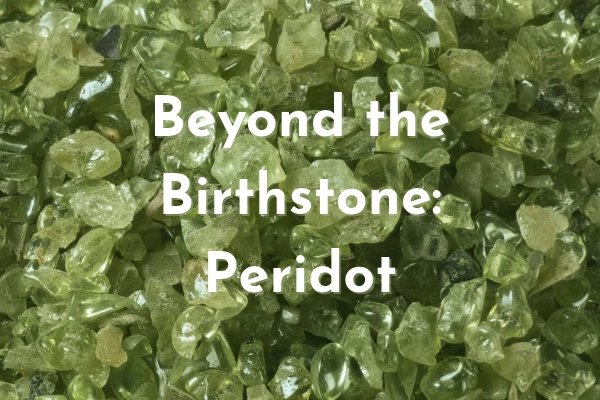
Birthstones have long been tied to the months of the year, valued for their color, rarity, and symbolic meaning. They show up in jewelry, anniversary traditions, and gift-giving customs around the world. But their significance runs deeper than ornamentation. The minerals behind birthstones are shaped by the same geological forces that supply essential materials to modern industry. Long before they are cut and polished, these minerals are prized for properties like hardness, thermal stability, and chemical resistance. Today, birthstone minerals and their chemical cousins support manufacturing, infrastructure, energy systems, and heavy industry.
August's birthstone is peridot — and it arrives from deeper within the Earth than any other gemstone in this series. While most gems form in the crust, peridot is one of only two gemstones (diamond is the other) that originates in the upper mantle, roughly 20 to 55 miles below the surface. It is the gem-quality variety of olivine, a magnesium-iron silicate with the chemical formula (Mg,Fe)₂SiO₄. The ratio of magnesium to iron determines both the specific gravity and the intensity of the green color — gem-quality peridot sits toward the magnesium-rich end of that range. Olivine rates 6.5 to 7 on the Mohs hardness scale and forms in the orthorhombic crystal system. Unlike most colored gemstones, peridot occurs in only one color: green, in shades ranging from yellowish to olive depending on iron content.
Most peridot reaches the surface the same way olivine does: carried upward by basaltic magma erupting from deep within the mantle. As the magma rises, it rips loose fragments of upper mantle rock — called xenoliths — and transports them to the surface. When the basalt weathers away over time, the more durable olivine crystals are freed and can be collected from the surface or from stream sediments.
Peridot Mesa, located on the San Carlos Apache Indian Reservation in Gila County, Arizona, has been described as the most productive peridot locality in North America — and by most accounts, the world. It is estimated that 80 to 95 percent of the world's production of peridot comes from the San Carlos Reservation, where olivine occurs as rounded nodules within basalt flows and can be collected from the surface as the basalt erodes. Other producing regions include Pakistan (which in the 1990s yielded some of the largest fine peridots ever found, some exceeding 100 carats), Myanmar, China, Vietnam, and Zabargad Island in the Red Sea — the ancient Egyptian source recorded as far back as 70 A.D.
Peridot has also arrived on Earth from space. Pallasites are a class of stony-iron meteorites in which olivine crystals are embedded in a matrix of nickel-iron metal, and current scientific consensus places their origin at the boundary between the silicate mantle and metallic core of differentiated asteroids — small planetary bodies that formed in the early solar system and were later shattered by collisions. The primary silicate mineral in pallasites is olivine, distinguishable by its greenish hue. Faceted gemstones cut from pallasite olivine are among the rarest collector gems on Earth — material that formed inside another planetary body billions of years ago and crossed the solar system to land here.
While peridot is prized as a gem, olivine's industrial value rests on a different set of properties: a high melting point, low and uniform thermal expansion, chemical stability, and freedom from the silicosis hazard associated with conventional silica sands. These properties make olivine useful across several demanding industrial applications.
The most established use is in foundry operations, where olivine is crushed into a sand-like form that avoids the hazards and limitations of conventional quartz-based foundry sands. Olivine is used as a moulding and core sand for casting steel and other metals. Compared to silica sand, olivine expands less and more uniformly when exposed to heat, which reduces casting defects and improves dimensional accuracy in finished parts. It is particularly suited to casting manganese steel and non-ferrous metals, and its absence of free silica makes it a safer alternative in facilities managing worker health risks. According to LKAB Minerals, olivine foundry sand also contributes to cleaner surface finishes and can withstand casting temperatures 300 to 400°F higher than silica sands allow. Domestic olivine foundry sand is produced from deposits in Washington state and North Carolina, per USGS industrial sand documentation.
In steelmaking, olivine serves as a fluxing agent in blast furnaces. Its high magnesium content aids in removing impurities from molten iron, forming a slag that can be separated cleanly from the metal. This contributes to cleaner steel and more efficient production chemistry, per LKAB Minerals.
In refractory applications, olivine's ability to withstand extreme temperatures without deforming or chemically reacting makes it suitable for lining furnaces, kilns, and industrial reactors. Olivine-based refractories — including bonded forsterite bricks, monolithics, and mortars — help extend equipment service life and reduce energy consumption by maintaining thermal stability in continuous high-heat environments.
An emerging application is enhanced weathering for carbon capture. When crushed olivine is spread on agricultural soils, it weathers — reacts with water and CO₂ — and in doing so draws carbon dioxide out of the atmosphere and releases magnesium and silica that can benefit soil chemistry. Research published in Frontiers in Climate and Environmental Science & Technology is actively investigating olivine's potential as a scalable carbon dioxide removal strategy. Results from field trials are promising, though researchers note that measurement methods and deployment protocols are still being developed and refined. This is an area of active scientific inquiry, not a settled solution — but one where olivine's natural chemistry gives it a genuine role to play.
Few minerals can claim origins both in the Earth's mantle and in the remnants of destroyed planets. The olivine behind August's birthstone keeps steel furnaces running, foundry lines producing, and industrial kilns operating. Minerals make it happen.
September 30, 2026

September 25, 2026
August 27, 2026