
October 15, 2026
October 15, 2026
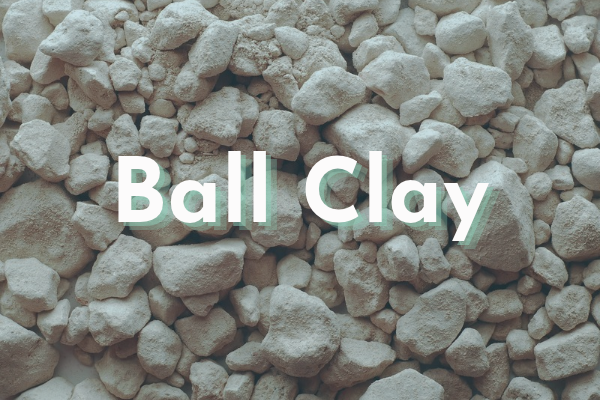
Ball clay didn’t get its name from a lab or a geologist’s field notes. It got it from the road. In 18th-century England, workers cut raw clay into rough cubes with a spade for transport. By the time those cubes had bounced across miles of cart tracks, the corners had worn off and the edges had rounded — so what arrived at the pottery looked like a ball instead of a cube. The name stuck, and 300 years later, it’s still what the industry calls one of the most useful clays on Earth.
Ball clay is a sedimentary, kaolin-based clay made up of 20 to 80 percent kaolinite, 10 to 25 percent mica, and 6 to 65 percent quartz, with a touch of organic matter mixed in. That organic matter is why raw ball clay comes out of the ground dark gray or black, even though it fires to a clean, light color — a trick of chemistry that makes it valuable for bright-white ceramics without needing heavy bleaching or additives.
Its real superpower is plasticity. It’s finer-grained than most other kaolin clays, which is exactly why potters and manufacturers can work it into intricate shapes and have it hold that shape through drying and firing without cracking or slumping. Few natural materials bend this easily and still hold a line this precisely.
Ball clay’s commercial story starts well before American tile plants or Tennessee quarries. According to the Clay Heritage Society, English pottery villages were using crude ball clay from Devon and Dorset as far back as Roman times, but the real trade took off in the 1500s, when tobacco pipe makers discovered how well it could be worked into thin, delicate stems. By the 1630s, Dorset pipe clay shipped out of the port of Poole was the single most valuable cargo moving through that harbor — so valuable that in 1662, England passed a law banning its export entirely, trying to keep the material (and the competitive edge it gave English potters) at home.
The ban didn’t last, and once it lifted, demand only grew. In the 18th century, potters in Stoke-on-Trent — including Josiah Wedgwood, Spode, and Astbury — built the English fine china industry on recipes that often called for equal parts ball clay, china clay, flint, and Cornish stone. Wedgwood’s famous Queen’s Ware owes its pale, durable body partly to ball clay. By 2000, English ball clay sales topped a million tonnes a year, with more than three-quarters of it exported to potteries around the world.
The United States built its own ball clay industry on the back of the English one — and then quickly outgrew the need for it. Per the U.S. Geological Survey, settlers in the Jackson Purchase region of western Kentucky and in West Tennessee were likely digging clay commercially as early as the 1820s, but it wasn’t until the late 1800s that anyone took the deposits seriously as an industry. Geologist R.H. Loughridge published one of the first scientific descriptions of the region’s clay beds in 1888, and production quickly became a measurable part of the local economy: between 1900 and 1904 alone, the area produced just over 1 million short tons of ball clay worth nearly $7.8 million.
World War I changed everything. With European clay imports effectively cut off, American potteries had to lean on domestic supply, and companies like the Kentucky-Tennessee Clay Company and EMA member Old Hickory Clay Company stepped in to fill the gap. By 1940, mines in the Eocene-age clay beds of West Tennessee and the Jackson Purchase were supplying more than 80 percent of all the ball clay used in the United States. Kentucky alone produced over 2.88 million short tons between 1900 and 1960, worth more than $25 million — and that same cluster of counties along the Kentucky-Tennessee border is still the heart of American ball clay production today.
The largest American ball clay reserves still sit in that same Mississippi Embayment basin, running through western Kentucky, western Tennessee, and northern Mississippi. Weakley County, Tennessee, alone holds some of the biggest deposits in the country, according to the Weakley County Economic Development Board, and as of the mid-2000s, USGS data showed Tennessee accounting for well over half of all U.S. ball clay production, with Texas, Mississippi, and Kentucky rounding out the rest.
The extraction method has obviously moved on from 18th-century spades. Hydraulic excavators now cut the clay from quarry benches, and mobile shredders — a technique dating to the 1930s — break it into golf-ball-sized chunks for shipping. From there, it gets refined into powder, “noodled” strips, or slurry, depending on what a buyer needs. Some of it is calcined, or fired at extreme heat, into chamotte (also called grog), a silica- and alumina-rich material that reinforces ceramic bodies so they don’t warp or crack under stress.
The numbers tell their own story about demand. According to the USGS Mineral Commodity Summaries, U.S. ball clay production has held around 1 million metric tons a year in recent years, with about 53 percent of it going straight into floor and wall tile. Exports have more than doubled since 2021, climbing from 139,000 metric tons to an estimated 320,000 in 2025 — proof that American ball clay, like its English predecessor a century earlier, is in demand well beyond its home borders.
Ball clay’s plasticity and light firing color put it to work across industries that rarely get mentioned in the same breath:
Ceramics and sanitary ware. Tile, sinks, toilets, tableware, and glazes all lean on ball clay to hold detailed shapes and fire to a clean finish.
Refractories. Kiln linings and other high-heat refractory products are made from ball clay precisely because it can take the heat required to fire everything else on this list.
Construction materials. Bricks, structural pipe, roof tiles, and pavement sealers all depend on its workability and durability.
Electrical insulation. Porcelain insulators that keep power lines safely grounded are built from ball clay for its strength and non-conductive properties.
Horticulture. Processed ball clay serves as a growing medium in hydroponic systems and a soil amendment that holds moisture and nutrients.
Polymers and fillers. It turns up as a filler in plastics, adhesives, and fertilizers, improving texture and consistency.
Environmental containment. Its low permeability makes it a go-to material for lining and sealing landfills, keeping contaminants out of groundwater.
From Roman-era pottery sheds to Wedgwood’s showroom to a quarry bench in Weakley County, ball clay has been reshaped, refired, and repurposed for centuries without losing its day job. It’s still earning its keep in bathrooms, kitchens, power grids, and landfills across the country — mined and processed domestically, supporting American jobs while building the physical infrastructure of modern life.
To see what other minerals are doing similar heavy lifting, visit EMA’s Meet the Minerals page, including close relatives of ball clay like kaolin, bentonite, and feldspar — all essential to the ceramics and construction materials we use every day.
October 15, 2026

September 30, 2026

September 25, 2026