March 11, 2026
March 11, 2026
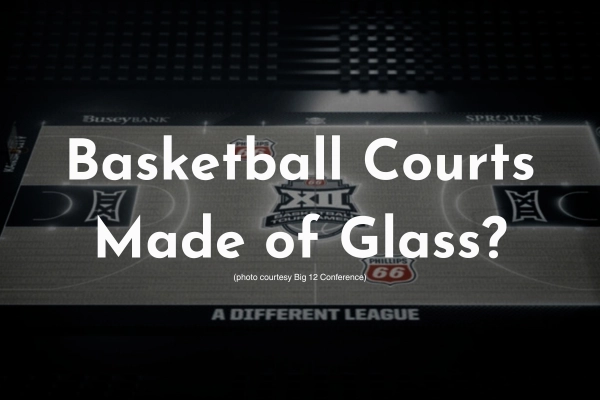
Kansas City's T-Mobile Center is buzzing this week with the 2026 Phillips 66 Big 12 Men's Basketball Tournament — and if you've tuned in, you may have noticed the floor looks... different. Very different. That's because for the first time in U.S. history, an official competition is being played on a full LED glass basketball court, courtesy of German firm ASB GlassFloor.
Yes, glass. Players are literally dribbling, cutting, and dropping defenders on a surface made of the same fundamental stuff as your kitchen window — just a whole lot more sophisticated. As a proud Iowa State Cyclones fan, I'll admit my attention this week is mostly on whether the Cardinal and Gold can make a run in Kansas City. But the geology nerd in me couldn't let this moment pass without asking: what exactly are those Cyclones running on?
Let's break it down.
The Big 12 Conference partnered with ASB GlassFloor — a Bavarian family business with roots in squash court manufacturing — to debut what the conference is calling a landmark moment in American sports. The floor made its first appearance during the women's tournament (March 4–9) and is now center stage for the men's event running through March 14.
The court isn't a single pane of glass dropped on a hardwood subfloor. It's a sophisticated, layered system built from multiple materials working together to keep athletes safe and the visuals dazzling. The playing surface itself consists of two layers of laminated safety glass, each panel approximately 5mm thick, bonded together with a 1.52mm PVB (polyvinyl butyral) foil in between. Beneath those panels sits an aluminum substructure — a spring-loaded framework of support rails and elastic mounts that gives the floor its bounce. Under all of that: thousands of LED lights that can display anything from team logos to shot charts to animated graphics, all changeable with a swipe on a touchscreen.
The result? A court that glows, reacts, and pulses — while still meeting every performance standard set by FIBA, the NBA, and the NCAA. In fact, ASB claims their glass surface is about 2.5 times more elastic than traditional hardwood, which means it may actually be easier on athletes' joints than a conventional wooden floor.
(Though some players this week have called it a little slippery. Our Cyclones? They handled it just fine. As evidence by our 49-point win today!)
Here's where things get genuinely cool — and where minerals take center stage.
The foundation of virtually all glass is quartz, the crystalline mineral form of silicon dioxide. Quartz is one of the most abundant minerals on Earth, found in everything from granite to beach sand, and it scores a 7 out of 10 on the Mohs hardness scale — tough, chemically inert, and incredibly stable. In glass manufacturing, silica sand (which must be at least 95 percent pure SiO₂) is the primary raw material, comprising roughly 72–73 percent of the final glass composition.
When silica sand is heated to temperatures around 1,600°C along with other compounds, it melts and loses its crystalline structure. Cool it quickly, and instead of re-crystallizing, it solidifies into the amorphous, transparent material we call glass. Every pane in the Big 12's GlassFloor started its life as quartz — a mineral that formed deep in the Earth's crust over millions of years.
Pure silica glass has a very high melting point and is expensive to produce on its own. To lower that melting temperature and make the glass workable, manufacturers add calcium carbonate (limestone) and sometimes dolomite (a calcium-magnesium carbonate mineral). Calcium oxide ends up comprising around 8–9% of typical flat glass, and magnesium oxide contributes another 4 percent. Together, these minerals improve the glass's hardness, chemical durability, and resistance to breakage — critical properties for a floor that needs to hold up under the force of Division I athletes.
Soda ash (sodium carbonate, Na₂CO₃) is another key ingredient, historically derived from mineral-rich brines or salt deposits. It accounts for roughly 13–14% of typical glass and works alongside lime to lower the melting point and increase the fluidity of molten glass during production.
Here's an interesting one specific to the ASB GlassFloor: the surface isn't perfectly smooth glass. To give athletes proper grip and prevent dangerous sliding, the top layer of each glass panel is treated in two ways. First, it undergoes a chemical deep-etching process that creates a matte texture. Then, elevated ceramic dots are burned into the glass surface at a precise size and frequency. Ceramics are typically composed of alumina (aluminum oxide, Al₂O₃) and silica — both mineral-derived materials — fired at high temperature to create a hard, friction-rich surface. These tiny dots are what let Audi Crooks plant her foot and explode to the basket without slipping.
Aluminum isn't technically a mineral — it's a metal element — but it's refined from bauxite, an ore containing aluminum-bearing minerals like gibbsite and boehmite. The entire spring substructure of the GlassFloor is built from aluminum alloy: lightweight, strong, and corrosion-resistant. This is what gives the court its shock-absorbing "bounce" and makes it dramatically more joint-friendly than concrete or even standard hardwood.
ASB says their GlassFloor system has a design lifespan of up to 70 years — far longer than any traditional hardwood court, which needs regular resurfacing and refinishing. The mineral-derived materials at the heart of it (glass and ceramic) simply don't degrade the way wood does. They don't warp, swell with humidity, or need to be sanded down after heavy use. Spill water on this floor during a timeout? The surface gets more visible, not slicker, as the matte finish turns transparent and lets players and officials spot wet patches immediately.
Meanwhile, beneath the players' feet, LED technology (driven by phosphor materials including rare earth minerals like cerium and europium in the semiconductor substrate) projects the Big 12 logo, sponsor graphics, and real-time game data. It's equal parts geology lab and Super Bowl halftime show.
Iowa State entered the 2026 Big 12 Tournament as the fifth seed with a 25-6 record — a team built for the big moment. Commissioner Brett Yormark reportedly heard from Iowa State's players during the women's tournament that they loved the floor and the environment. And honestly? With a court this technologically advanced sitting beneath their sneakers, the Cyclones have no excuses.
The minerals did their job. The glass held up. Now it's time for the Cardinal and Gold to do theirs.
Minerals Make It Happen.
March 24, 2026
March 11, 2026
March 10, 2026