December 3, 2025
December 3, 2025
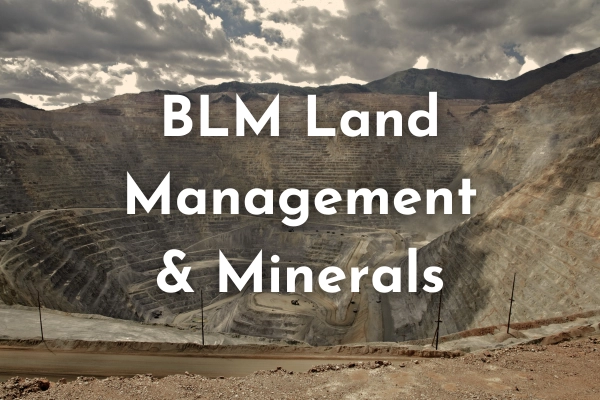
The Bureau of Land Management (BLM) is the steward of roughly 10 percent of the United States and a significant portion of the nation’s mineral estate. Its authority and mission stem from the Federal Land Policy and Management Act of 1976 (FLPMA), which directs the agency to manage public lands for multiple use and sustained yield. FLPMA is foundational for the minerals industry because it guarantees predictable access to federal lands, which are home to minerals critical to national security and the economy. This framework ensures that public lands serve a broad range of needs while maintaining long-term stewardship responsibilities.
FLPMA frames public land management as the ability to allow a variety of compatible uses — not a single-purpose mandate. Under that umbrella, BLM performs land-use planning, issues permits and rights-of-way, authorizes grazing, supports both recreation and conservation programs, oversees timber and fuel projects, and administers energy and mining activity. Those decisions are guided by land-use plans that are supposed to weigh the benefits and impacts of competing uses and to promote sustained yield of resources over time.
This practical flexibility is why FLPMA is often described as a framework for managed coexistence or routing development to suitable places, avoiding or mitigating serious resource damage, and preserving opportunities for future land users.
BLM lands support ranching, energy and mineral development, and recreation — activities that generate jobs, tax revenue, and services in rural communities. Many counties rely on BLM-authorized activities for livelihoods, and unpredictable or exclusionary policy swings that effectively remove traditional uses can destabilize local economies. Country governments cannot levy property taxes on BLM land, underscoring the dependence of many rural communities on the responsible development of BLM land to generate revenue for services such as schools, health care, and emergency services. BLM’s multiple-use framework provides predictable rules and local planning tools that allow communities and businesses to invest with some confidence.
Multiple use, applied through land-use planning, lets managers site development where it causes the least harm and prioritize conservation in sensitive areas. That targeted approach tends to produce better environmental outcomes — and fewer unnecessary conflicts — than blanket exclusions that can simply shift impacts elsewhere or drive activity to foreign jurisdictions with weaker standards.
Roughly one-third of the nation’s minerals lie under BLM-administered lands, for which the agency administers mining claims, leasable mineral rights, and other minerals programs. Domestic mineral production contributes directly to the U.S. economy — more than $100 billion in recent years — and supports supply chains for manufacturing, energy, infrastructure, and defense. Maintaining responsible access to these resources on federal lands is therefore strategically important.
Federal programs and policy increasingly emphasize “critical minerals,” which are defined as minerals that are essential to the economy and national security and that face supply-chain risks. The Department of the Interior and other agencies have formalized lists and programs to shore up domestic supplies. If federal lands were managed in a way that unduly restricts timely, responsible mineral development, it would undercut those broader national security objectives. In short, land-use policy and mineral policy are linked: preserving multiple use supports the domestic production of critical minerals.
Multiple use is not “use at any cost.” FLPMA and BLM’s rules require environmental analysis, permitting conditions, and reclamation bonds; modern federal mining and energy projects routinely include mitigation, monitoring, closure, and reclamation plans. This means the nation can develop resources while minimizing and managing environmental impacts, rather than outsourcing environmental harm to foreign producers with weaker protections.
Two legal layers matter: FLPMA governs how BLM manages surface lands and balances uses; separate mining statutes control the right to explore and develop particular mineral types. For locatable hardrock minerals, the General Mining Law of 1872 remains relevant; for leasable minerals (coal, oil and gas, trona, uintaite, and some uranium) and saleable minerals (sand, gravel), other statutes and regulations apply. BLM administers claim records, fees, environmental reviews, and reclamation for these activities and collects fees and bond funds intended to protect taxpayers and the environment.
The result is a system where mineral access is possible — but conditioned on planning, environmental review, and post-operation reclamation. That structure helps reconcile the practical need for domestic minerals with the public interest in safeguarding landscape values for future generations.
Keeping FLPMA’s multiple-use, sustained-yield framework at the center of BLM decision-making is a pragmatic way to protect both public-land values and the nation’s economic and security interests. It allows the United States to develop land where it’s appropriate, requires strong environmental controls, and still maintains access to minerals, energy, and livelihood uses that underpin rural economies and critical supply chains. Preserving that balance with rigorous science, transparent planning, and meaningful mitigation is the practical path to both conservation and national resilience.

August 27, 2026

August 12, 2026

July 30, 2026